
We gather together

I woke up in the warm summer morning. The sun had just risen as I washed and dressed in Eileen’s Trees Inn, just outside the gates of the Ngorongoro Crater. I looked out the window and took in the wide view of the Tanzanian mountains before heading to breakfast. My guide Hans joined me there before we set off for the long drive to Serengeti Park.
Several hours into the drive, I asked Hans if we would come anywhere near the Olduvai Gorge. He pointed out into the grass-covered plain toward a set of hills in the distance. He said, “There, it’s very close, only about 20 kilometers. You know about the gorge?”
I nodded. A strange feeling had come over me and urged me to ask the question. A feeling that I had been in this place before. Even in my distant mind.
Though only viewing from a distance, I could sense the place and our connection to it. The gorge follows the shoreline of an ancient lake, rich in fossils of our ancestors. The remains of the first humans, Homo Habilis, dating back almost 2 million years, were found there in the 1960s. We, and when I say we, I mean Homo Sapiens, arrived recently on the gorge scene about 300,000 years ago. A place to remember to visit on the next trip.
Hans and I continued on and entered the park, soon leaving the main road and setting out across two tracks in the flatten grass. The land cruiser shook and rattled as we made our way toward a rock outcropping and a pride of lions sleeping in the afternoon sun. We passed a male elephant scratching himself against the remains of a tree, his trunk in the air in ecstasy at how it felt. A cheetah guarded its fresh kill, still panting from the hunt. All encountered within the first hour.
We could see a group of vehicles in the distance. This sight typically denotes something to stop and see. As we got closer, we saw there were people standing outside of the vehicles. Definitely not wise when encountering a wild animal. Especially when they will eat you.
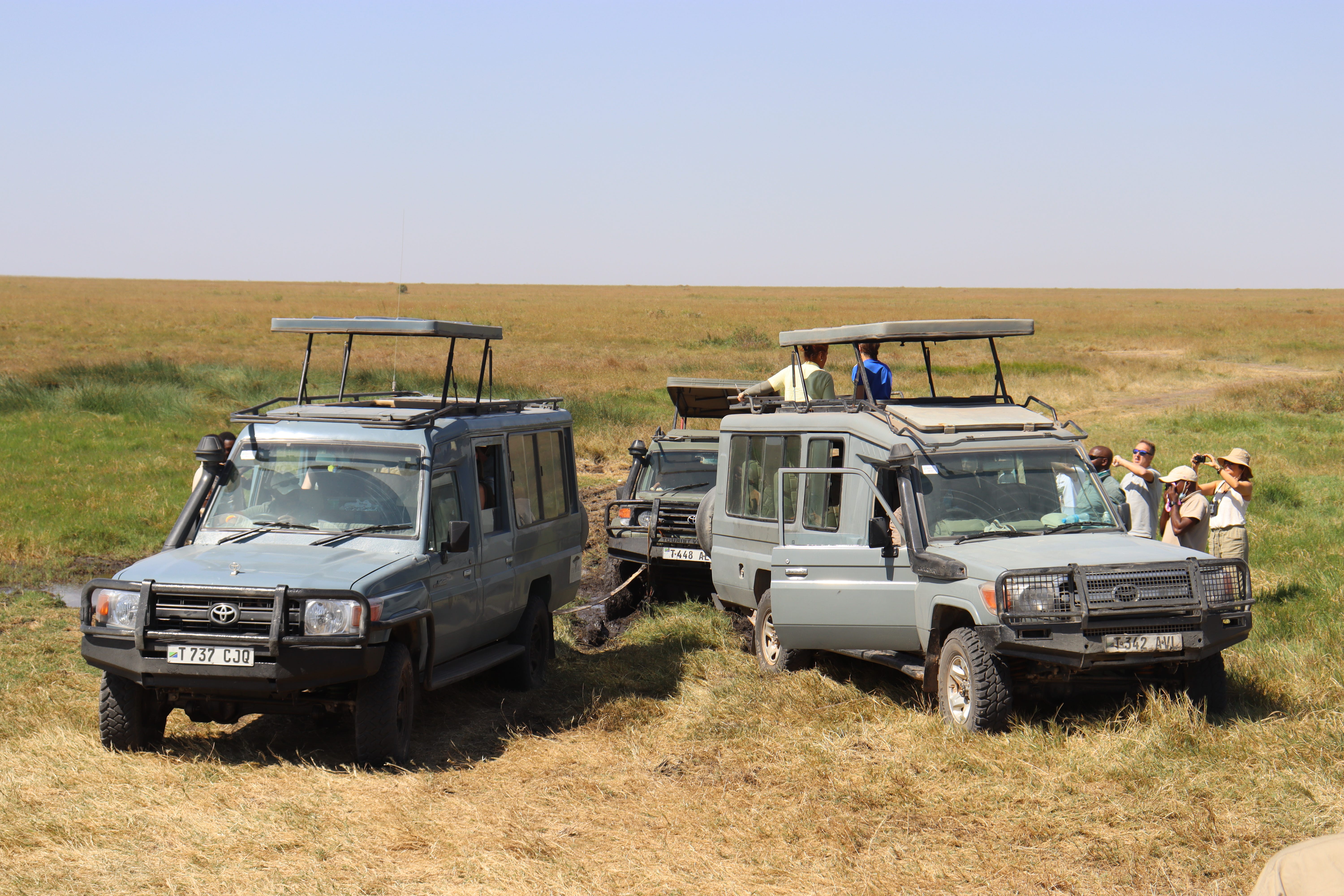
We arrived and pulled close to the group. A land cruiser tried to cross a small wet area and stuck fast in the mud, the water now deep around the tires. The passengers had climbed out and jumped to the high dry ground, watching intently.
My driver motioned to a second driver, and they quickly sprang into action. They pulled their vehicles around and backed toward the marshy ground, careful not to become struck themselves. They attached ropes from their two rear bumpers to the front bumper of the stuck vehicle. With lots of coordinated shouting, engines revved and the pulling and tugging began, rocking back and forth. Several attempts were made to free the stuck vehicle. Just when it looked that it would not budge, they pulled one more time. The land cruiser suddenly lurched forward. Moving from the deep muck to shallower water then onto dry ground.
Great cheers and applause went up from the occupants of all three vehicles. Proud of the skill and courage of the drivers. Snacks and drinks appeared. And an impromptu party of strangers erupted.
One of the words that rang out that day was the word “pamoja.” A Swahili word that always stands out in any conversation. In its simplest form, the word “pamoja” translates into English as “together.” It is often accompanied by a hand gesture making a circle, like the speaker is holding an imaginary ball between open hands. But pamoja signifies something deeper. An all-encompassing word that pushes inward and holds all the speaker’s thoughts together.
Pamoja is best illustrated in the African proverb: “If you want to go fast, go alone. If you want to go far, go together.” Pamoja reminds us that we are all connected and that we are not separate from our larger community.
Pamoja. Everywhere I went, throngs of people greeted our cars. Whole villages in fact. With shouts of welcome, traditional songs and dancing. No one was left out from the youngest to the oldest. I felt compelled to leap out of the car and dance with them. To become one with them in their welcome. All of us in this dance of life together.
Pamoja. When dinner was served, everyone sat down to eat. Men were joined by women and children. Food was passed and eaten until all were satisfied with the meal and conversation. Rice, beans, stewed chicken, vegetables, watermelon. We always dined together.
Pamoja. When someone found themselves in trouble, like the vehicle stuck in the mud, everyone rallied to assist. No judgments, only helping hands. They worked collectively to solve the problem and ensure everyone’s safety. In the end, a celebration and a common experience bound us all together.
Our early ancestors were smart to stay in the Olduvai gorge. Very smart. We knew we had a good thing. Temperate climate, fresh water, plentiful game and grasses. Our ancestors lived in the gorge for another 250,000 years before venturing out. First migrating to Asia and Europe, and eventually to the Americas. We just had to see what was over the next hill.
Maybe it was more than location that made us stay so long, to keep us calling the gorge home. Maybe it was pamoja that kept us from moving away. We thrived on the camaraderie, support and safety of one another.
Wherever we call home, there is a connection beyond physical place, extending to the people around us. Our family, our friends, our neighbors, our world. Pamoja binds us all and creates a true sense of belonging. In this season of gratitude, let us be thankful together.